
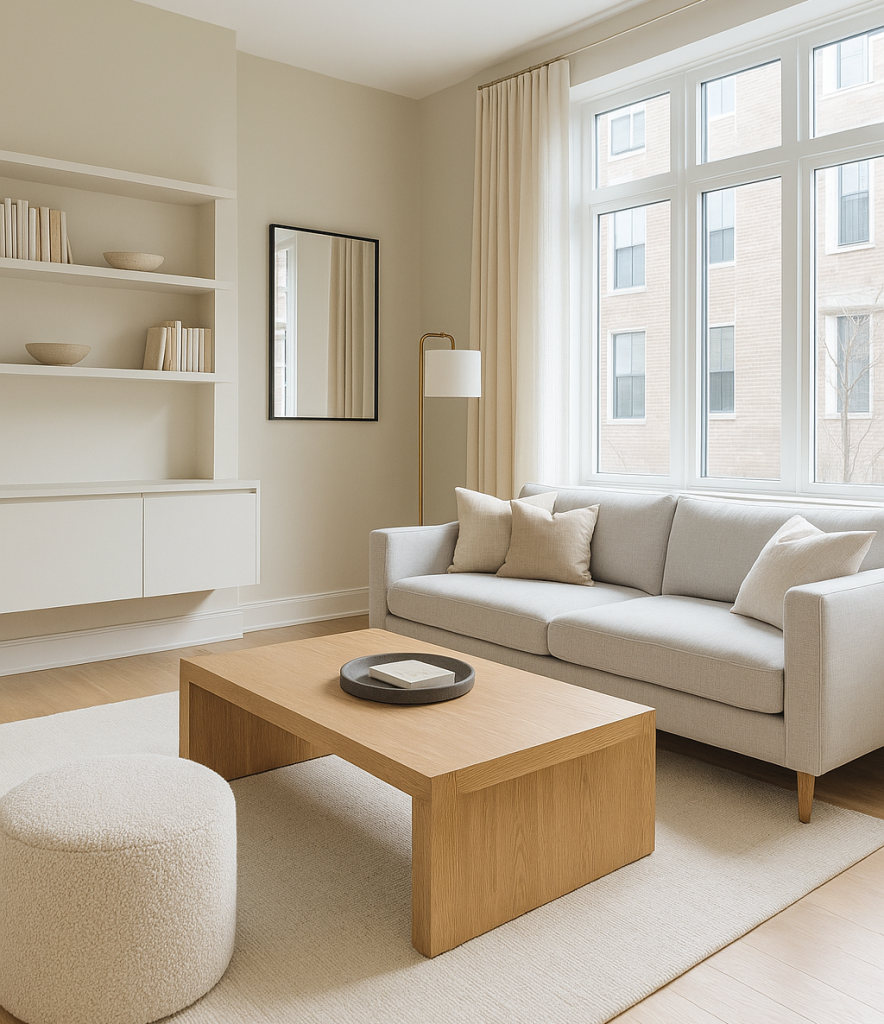
Living in a small condo, basement suite, or compact home doesn’t mean you have to feel cramped. With the right renovation strategies, even the tiniest spaces can look brighter, more open, and far more functional.
This step-by-step guide will show you how to renovate a small space to make it look bigger, with real numbers, Canadian cost examples, and pro tips.
Step 1: Start With the Flow
Before picking up a paintbrush or choosing tiles, measure your space carefully.
- Walkways should be at least 30–36 inches wide.
- Each swing door eats up around 8–10 ft² of usable area.
- Switching to pocket doors or sliders instantly frees up floor space.
Pro Tip: Sketch your floor plan or use a free phone app. You’ll spot traffic bottlenecks right away.
Step 2: Use Continuous Flooring
A single flooring type makes a small home feel larger by removing visual breaks.
- Run planks parallel to the longest wall to stretch the room visually.
- Choose large-format tile (24×24) in bathrooms with matching grout for a seamless look.
Cost in Canada:
- Luxury Vinyl Plank (LVP): $3–$5/ft² materials + $3–$5/ft² installation
- Tile: $4–$10/ft² materials + $8–$15/ft² installation
Step 3: Choose Light, High-LRV Paint
Paint is one of the most affordable upgrades with the biggest impact.
- Walls: light neutrals with LRV 70–78
- Ceilings & trim: bright white with LRV 85+
- One-color strategy: use the same shade on walls and trim to blur edges and visually expand the space.
Step 4: Layer Your Lighting
Lighting can make or break a small space. Instead of one overhead fixture, combine layers of light.
How Many Lumens You Need
- Living/bedrooms: 20–30 lumens per ft²
- Kitchens/work areas: 30–50 lumens per ft²
Example: 500 ft² Studio
Target = 10,000 lumens total
- 6 recessed lights (800 each) = 4,800
- 2 floor lamps (1,000 each) = 2,000
- LED cove strip = 2,000
- Under-cabinet/task = 1,200
Color and Quality
- Warm white (2700–3000K) for cozy areas
- Neutral white (3000–3500K) for kitchens
- Always use CRI ≥ 90 for true color rendering
Step 5: Maximize Storage Without Bulk
Clutter kills space. Build smarter, not bigger.
- Use shallow built-ins (12–15″) that run to the ceiling.
- Go for wall-hung furniture like vanities and TV consoles.
- Choose push-latch doors or integrated pulls for a seamless look.
Costs:
- Wall-hung vanity: $600–$1,500
- Custom built-ins: $200–$800 per linear foot
Step 6: Dress the Windows Right
Window treatments can make ceilings look taller.
- Mount drapery 6–12 inches above the frame.
- Extend rods 6–10 inches beyond each side.
- Use floor-to-ceiling panels in light fabrics close to the wall color.
Step 7: Add Mirrors and Glass
Mirrors double the sense of depth in a room.
- Size them at least two-thirds the width of the furniture below.
- Place opposite or diagonal to a window to bounce daylight.
Glass also helps: frameless shower panels or glass partitions keep sightlines open.
Step 8: Choose the Right Furniture
Scaled furniture prevents overcrowding.
- Sofas: 72–84″ wide, 32–36″ deep
- Coffee tables: ~⅔ of sofa width with 18″ clearance
- Dining tables: drop-leaf or extendable for flexibility
- Beds: wall-bed/Murphy or storage beds for function
Real-Life Example: 500 ft² Toronto Condo
Here’s a sample renovation scope:
- Continuous LVP flooring → $4,000–$5,000
- Light, high-LRV paint → $1,500
- Pocket door at bathroom → $1,000
- Full-height drapes + large mirror → $800
- Layered 10,000 lumen lighting → $2,500
Total Investment: ~$10,000–$12,000
Result: The home feels 20–25% larger without changing the footprint.
Common Mistakes to Avoid
- Mixing too many flooring types
- Using dark, high-contrast paint
- Relying only on ceiling downlights
- Choosing oversized furniture
- Hanging curtains too short
FAQs
What paint color makes a small room look bigger?
Choose light colors with LRV above 70. Off-whites and pale neutrals work best.
Is continuous flooring better for condos?
Yes — one flooring type throughout creates visual flow and eliminates choppy transitions.
How much does it cost to renovate a small condo in Toronto?
Expect $10,000–$15,000 for a cosmetic refresh (floors, paint, lighting, minor upgrades).
Do pocket doors really save space?
Yes. Each swing door reclaims about 8–10 ft² when replaced with a pocket or sliding door.
Final Thoughts
A small home doesn’t need to feel limiting. By focusing on flow, light, and clever design, you can transform a cramped condo or basement into an airy, functional, and stylish living space.
With smart renovations, even a modest budget can make your space look and feel significantly bigger.